Small bahay kubo: the questions to settle before you build one
Planning a small bahay kubo for the yard or family land: what it is for, its size, where it goes, permits, who builds it, typhoons, and how long it lasts.
Most small bahay kubo are built by a family for a plain reason: shade in the yard, a place to eat outside, a spare room for visiting relatives, or something on the family land in the province. The design is the easy part. What decides whether it works is a handful of questions about use, size, place, permits and weather, and they are easier to answer before the posts go in. This guide takes them in the order they usually come up. The images are design concepts, generated to show ideas. None is a built kubo or the practice’s work.
For what the parts are called, read the bahay kubo guide. For layouts, roofs and walls, read the bahay kubo design guide.
What is it for?
Everything else follows from this, so settle it first.
| Use | What it usually means |
|---|---|
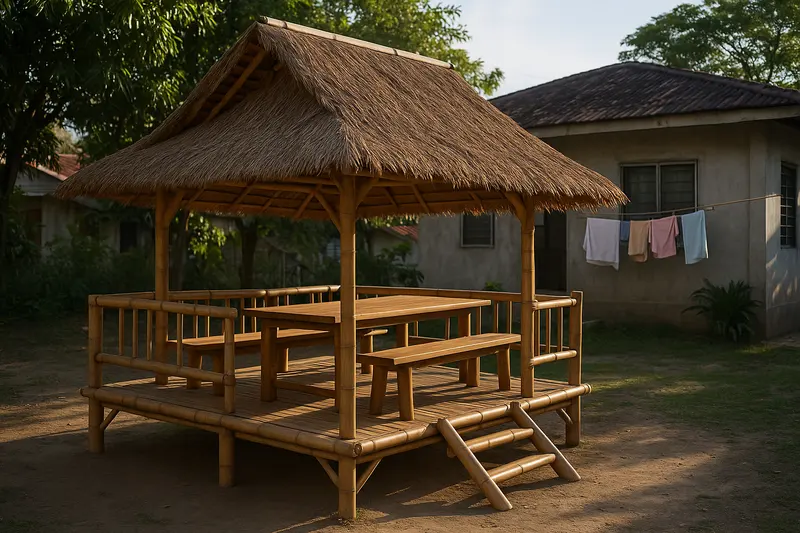
| A tambayan or garden kubo, for eating and resting | An open platform or one open room, a few steps up, no walls or low rails only. Bamboo and thatch suit it |
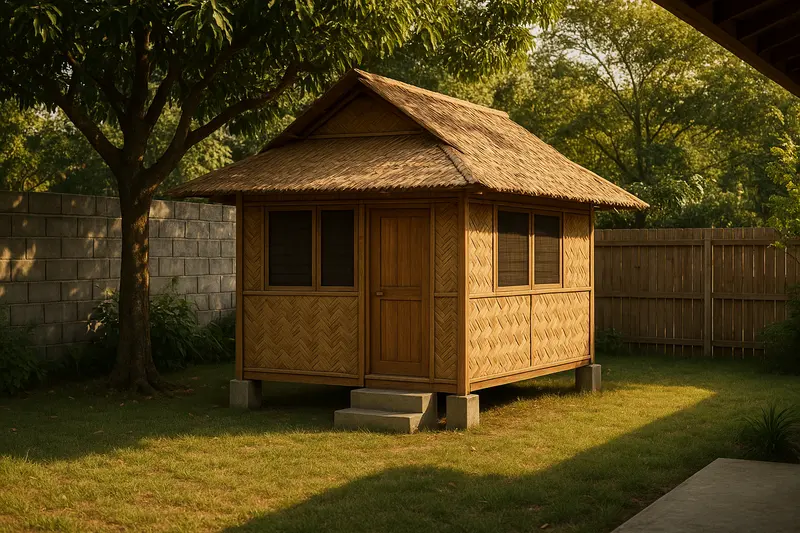
| A spare room for sleeping | Walls, a door that locks, screens against mosquitoes, and power for a light and a fan |
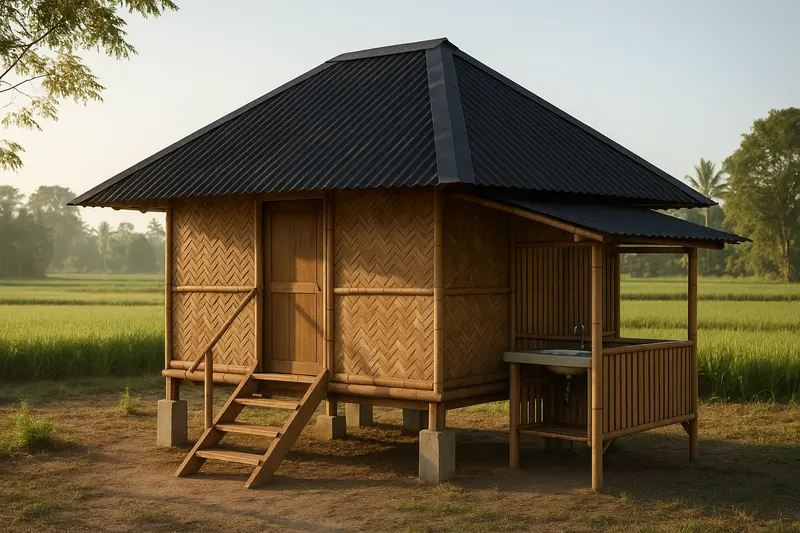
| A small house to live in | A kitchen sink, a toilet and bath, proper wiring, and a structure that lasts. At this point it is a house, and the modern bahay kubo guide is the better starting point |
| A rest house on family land | Often empty for weeks, so it has to lock up and stand up to weather with nobody there. The rest house guide covers that |
How big should it be?
Size it from what goes in it. Lay out the table and benches, or the bed, on the ground where the kubo will stand, mark the floor with string and stakes, and walk around it. A floor that looks generous on paper often feels tight once there is a table in the middle and people need to get past it. If a sleeping kubo is ever going to count as a room in the house, the room size checker shows the minimum sizes the rules set.
Plan for growth at the start. A bahay kubo was always built in modules, so a second room, a porch or a batalan can be added later if the posts and the roof are laid out for it.
Where on the lot?
- Catch the breeze, and get shade in the afternoon. The west sun is the hot one. A tree or the house itself on that side helps.
- Keep thatch away from fire. Well clear of the kitchen, the grill and any burning of leaves.
- Stay off low ground. Wherever water collects in a heavy rain, the posts will stand in it. Ask the neighbours how high the water has reached, and lift the floor clear of it. The elevated house guide covers how.
- Keep away from large trees. The Shelter Cluster’s Build Back Safer guidance, written after Typhoon Yolanda, says to build away from large trees, or cut back the ones near the house, so a falling branch does not take the roof.
- Mind the boundary. A structure close to the property line can block a neighbour’s light, drain onto their lot or fall within an easement. The right of way and easements guide explains what the law says about building near a boundary.
Does it need a building permit?
The National Building Code (PD 1096) applies to every building except traditional indigenous family dwellings, under Section 103(a), and Section 301 says no one may build without a permit from the building official. Whether your kubo falls under the exception is the building official’s decision, so ask at the municipal or city building office before you build. A kubo with wiring, plumbing, or a concrete or steel structure is a building like any other. The building permit requirements guide lists what the office asks for, including proof of ownership, or the owner’s written consent if the land is not yours.
In a subdivision, check the homeowners’ association rules as well. Some restrict structures in the front yard or set their own setbacks.
Who builds it?
A carpenter who knows bamboo can build a garden kubo, and many barangays have one. Ask to see kubo they have built, and ask where they buy their bamboo and how they protect it. Once it is a room people sleep in, or it has wiring, a toilet or a second level, it needs drawings, and the electrical and plumbing work needs licensed people. For anything the size of a house, read the guide to hiring a contractor first.
Bamboo posts or concrete?
Bamboo is light, quick to work and easy to repair. It also needs treating against insects, and it rots in the ground. Concrete footings with bamboo or timber above are the usual middle way. The bamboo bahay kubo guide goes through each material, how long it lasts and the yearly upkeep.
Will it stand up to a typhoon?
The Build Back Safer key messages are written for small, lightweight houses like this one. In short:
- Strong foundations. Posts on concrete footings, anchored, with the timber or bamboo kept off the wet ground.
- Tie it down from the bottom up. Posts to footings, floor to frame, roof frame to posts, roof battens to the roof frame.
- Brace it. Diagonal braces in the walls and between the posts if it stands on stilts, at about 45 degrees.
- Strong joints, with more than one nail and with straps where members meet.
- A good roof. A pitch of about 30 degrees for metal sheet, eaves of 45 cm at most, and extra fixings at the edges.
- A safe site, above the flood and away from trees and slopes.
- A simple shape. No longer than three times its width, and any lean-to roof kept separate from the main roof.
The bahay kubo’s tall roof and deep eaves pull against points 5 and 7, and a thatched roof needs a steeper pitch than metal. The fix is to tie the roof down properly. The bamboo bahay kubo guide explains the trade-off.
Power and water
Run power through its own circuit from the house panel, installed by a licensed electrician, never an extension cord stapled along the bamboo. A sink or toilet needs water in and waste out: a batalan at one side, with its own drain, keeps the wet away from the main floor. A toilet needs a septic tank or a connection to a sewer, and the septic tank guide explains what that involves.
How long will it last?
That depends on the roof, the bamboo and the upkeep more than anything else. Single-layer nipa shingles may last only a year or two. Double-layer shingles, well made and maintained, have lasted far longer. Bamboo kept dry and off the ground, and protected against insects, lasts many years. Bamboo set in wet soil does not. The bamboo bahay kubo guide has a yearly upkeep calendar.
When to bring in an architect
For a garden kubo, usually you do not need one. For a kubo that will be lived in, built in concrete, steel or timber, wired and plumbed, or on a lot with tight boundaries or a flood problem, the drawings for the permit have to be signed by licensed professionals. Our custom house design service designs bahay kubo-style houses and rest houses for a particular lot. If you want to see the heritage version of the same ideas in stone and timber, read the bahay na bato guide.
Sources
- National Building Code of the Philippines (PD 1096), Sections 103(a) and 301.
- Shelter Cluster Philippines, 8 Build Back Safer key messages.
- Shelter Cluster Philippines, Key messages for commonly used shelter materials: nipa thatching, version 1.1, October 2014.
More guides
- Why a 3D walkthrough is worth doingWhat a virtual walkthrough shows that a floor plan cannot, and why changing a wall in a model costs nothing while changing it on site costs a great deal.
- 50 sqm house design in the Philippines: what fits on the floor and on the lotHow big 50 sqm is (5 m by 10 m), what a 50 sqm house holds, a 50 sqm lot under the lot coverage and BP 220 rules, and when to build up on a 100 sqm lot.
- How architect fees work in the PhilippinesThe four ways architects in the Philippines charge, what each one suits, what moves the number, and which costs are the architect's fee and which are the build.