Bamboo bahay kubo: the materials, how long each one lasts, and the upkeep
Bamboo bahay kubo materials: which bamboo goes where, nipa, cogon and metal roofs, woven walls and rattan ties, what wears out first, and a year of upkeep.
A bamboo bahay kubo is built almost entirely from plants: bamboo for the posts, frame and floor, nipa, cogon or anahaw leaves for the roof, woven bamboo for the walls and rattan to tie it together. Those materials are easy to find and easy to replace, and they also wear out, so a bamboo kubo comes with work every year. This page goes through each material, what attacks it, how long it lasts and what the upkeep looks like. It gives no prices, because they change by province and by season. The images are design concepts, generated to show ideas. None is a built house or the practice’s work.
For the names of the parts, read the bahay kubo guide. For a house that keeps the look with less upkeep, read the modern bahay kubo guide.
Which bamboo goes where
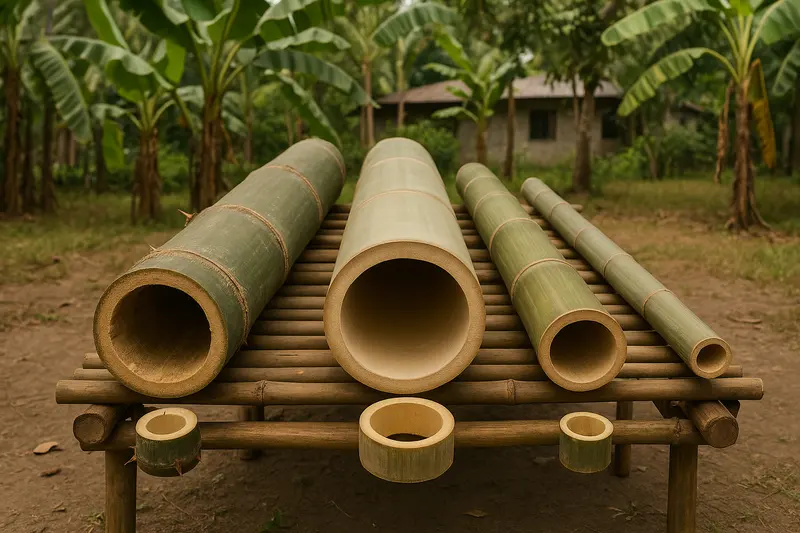
Not every bamboo does every job. Builders pick by wall thickness and size.
| Bamboo | Local name | Where it is used |
|---|---|---|
| Bambusa blumeana | kawayan tinik | Posts, beams and the frame. Thick walls and strong, but thorny to harvest |
| Dendrocalamus asper | giant bamboo, botong | Posts and heavy members, where a wide culm is wanted |
| Gigantochloa levis | bolo | Frame members, floor slats and split work |
| Schizostachyum lumampao | buho | Thin-walled, split and woven into sawali wall panels |
Ask the supplier which kind you are buying and how old the culms are. A culm cut young is soft and full of starch, and it splits and rots sooner.
What attacks bamboo, and what stops it
Bamboo has three enemies.
- Bukbok, the powder-post beetle. It is drawn to the starch in the culm. The sign is a fine dust under a beam or slat, and small round holes.
- Anay, termites. They come up from the ground. The sign is mud tubes on a post or footing.
- Rot. Bamboo that stays wet, in soil or in standing water, decays from the outside in.
Three things keep them off, and a kubo needs all three:
- Mature culms, cut and dried properly. Bamboo cut in the dry season and left to dry before use carries less starch and less water.
- A preservative. The common one is a boron solution, boric acid with borax, which the bamboo is soaked in or which is pushed through the culm under pressure. Practical Action’s guide to bamboo preservation rates it for bamboo under cover only, because boron washes back out of bamboo that gets wet. Bamboo set in the ground needs a stronger treatment, or a concrete footing instead.
- Design that keeps it dry. This matters most. Stand every post on a concrete or stone footing, never in the soil, and keep the bamboo under the roof and out of the rain. The Shelter Cluster’s Build Back Safer guidance, written after Typhoon Yolanda, shows posts set on concrete with a gap under the timber so it does not sit in water.

The roof
The roof wears out first, and it decides most of the upkeep.
| Roof | How long it lasts | What to know |
|---|---|---|
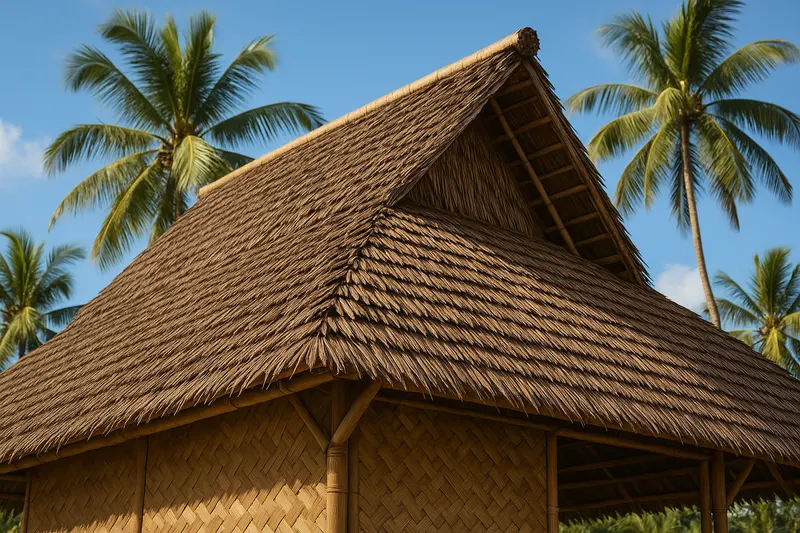
| Nipa shingles (pawid) | 1 to 2 years for single-layer shingles. Up to 10 years has been reported for double-layer shingles that were harvested, stored and maintained well | Buy double-layer shingles made from mature leaves. Keep stock dry before it goes up. Check it every year |
| Cogon grass | Varies with the grass and how thick it is laid | Light and cool, but burns easily |
| Anahaw leaves | Varies with the leaves and how they are laid | Used where it grows. Each leaf is large, so it goes up quickly |
| Kalaka (halved bamboo) | As long as the bamboo stays sound | Each piece runs the full slope and carries the rain down its channel. Needs the same preservative as the frame |
| Metal sheet | Many years | Little upkeep, but hot and loud in rain unless insulated under it |
The figures for nipa come from the Shelter Cluster’s 2014 note on nipa thatching for the Philippines. The same note recommends a roof pitch of at least 40 degrees for nipa, so the rain runs off the shingles before it can soak through, and it lists the trade-offs plainly: nipa needs maintenance every year and raises the fire risk.
Two warnings come with a steep thatched roof:
- Changing it to metal later. A pitch that suits nipa can be a typhoon risk under metal sheet, because wind passes through thatch but pulls hard on a sealed sheet. Ask whoever designed the frame before you swap.
- Long eaves in a typhoon. Deep eaves keep sun and rain off the walls, and the bahay kubo is known for them. The Build Back Safer guidance keeps eaves to 45 cm at most, because wind gets under a long overhang and lifts the roof. A kubo that keeps longer eaves needs its roof tied down properly to the posts, from the bottom up. For a house you will live in, the structural engineer sizes those ties.
The walls
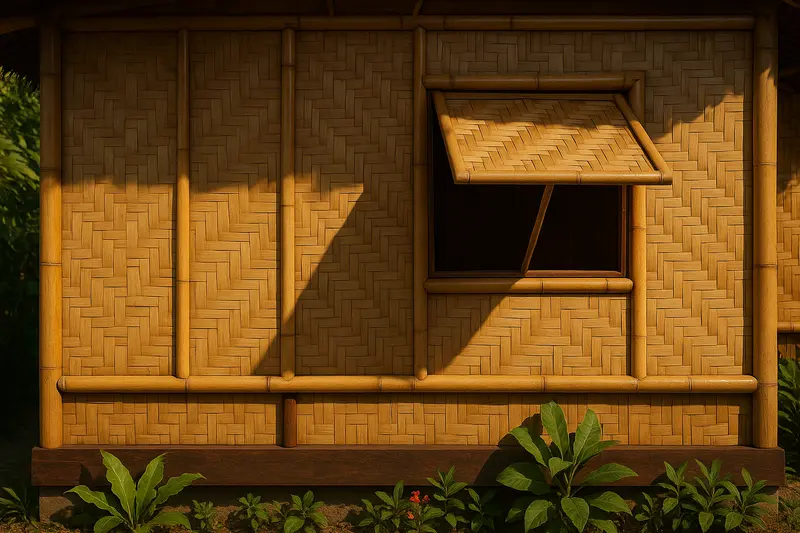
- Sawali and amakan, woven bamboo panels. They let air through and are quick to replace one panel at a time. They also let dust and insects in, so a room for sleeping usually has screens behind them.
- Sala-sala, an open bamboo lattice, for a porch or the silong.
- Timber boards or slats, which last longer and lock.
Woven panels fail at the bottom first, where rain splashes up. A low skirting of a harder material, and eaves that keep the rain off, add years to them.
The floor
Split bamboo slats, laid with gaps, let cool air up from the silong. Individual slats crack and work loose over time, and the usual fix is to replace them one by one. Furniture legs wear them fastest, so a kubo that will hold a table and chairs often gets timber boards in that area.
The joints and ties
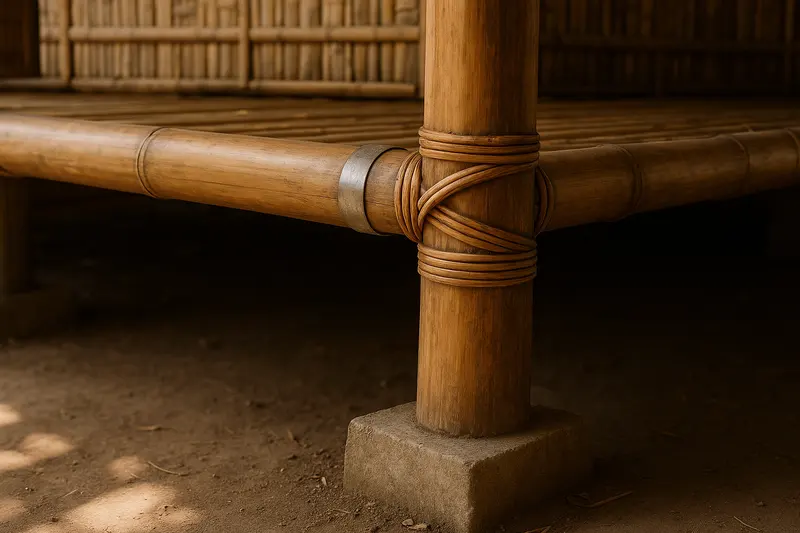
A traditional kubo is lashed with rattan and fitted, with few or no nails. Rattan loosens as it dries out and ages, so ties need checking every year. Build Back Safer’s advice for typhoons is to tie every part down to the ground, starting from the bottom: posts to the footing, floor joists to the frame, the roof frame to the posts, and the roof battens to the roof frame. It rates galvanised steel straps and thick galvanised wire, wrapped several times, as the strongest ties. The Shelter Cluster’s nipa note adds that bamboo soaked before nailing is less brittle and less likely to split.
A year of upkeep
| When | What to do |
|---|---|
| Before the rains, around April or May | Walk the roof from below and from a ladder. Replace thin or broken shingles. Re-tie loose rattan. Check that every post still stands on its footing |
| After every typhoon or strong wind | Look for lifted or missing shingles, and ties that have slipped. Fix them before the next rain |
| Twice a year | Look for bukbok dust and termite tubes. Replace any piece that sounds hollow when tapped |
| In the dry season | Replace worn floor slats and wall panels. Clear leaves and debris off the roof and out of the silong |
| Every few years | Re-thatch. How often depends on the roof material and how well it was laid |
What the upkeep costs, without the numbers
The material is cheap to buy. The cost is the labour and the replacement material every year, and a full re-thatch every few years. A metal roof, concrete footings and timber in place of bamboo for the posts each cost more at the start and cut the yearly work. Most families who want a kubo to live in end up with a mix: a structure that lasts, with bamboo and woven panels where they can be replaced easily. The modern bahay kubo guide shows that approach, and the bahay kubo design guide compares the roof and wall choices side by side.
When bamboo is the wrong choice
- A house to live in all year. Use a concrete or steel structure and keep bamboo for screens, ceilings and finishes.
- Near a kitchen, a grill or a neighbour’s wall. Thatch burns. Keep it well clear.
- A low, wet site. Lift the floor clear of the flood, as the elevated house guide explains, and keep every piece of bamboo out of standing water.
If you are deciding whether to build a small kubo at all, the small bahay kubo guide goes through the questions to settle first. The larger heritage house built from the same ideas, in stone and timber, is in the bahay na bato guide.
Sources
- Shelter Cluster Philippines, Key messages for commonly used shelter materials: nipa thatching, version 1.1, October 2014.
- Shelter Cluster Philippines, 8 Build Back Safer key messages.
- Practical Action, Bamboo Preservation, technical brief.
More guides
- Why a 3D walkthrough is worth doingWhat a virtual walkthrough shows that a floor plan cannot, and why changing a wall in a model costs nothing while changing it on site costs a great deal.
- 50 sqm house design in the Philippines: what fits on the floor and on the lotHow big 50 sqm is (5 m by 10 m), what a 50 sqm house holds, a 50 sqm lot under the lot coverage and BP 220 rules, and when to build up on a 100 sqm lot.
- How architect fees work in the PhilippinesThe four ways architects in the Philippines charge, what each one suits, what moves the number, and which costs are the architect's fee and which are the build.